



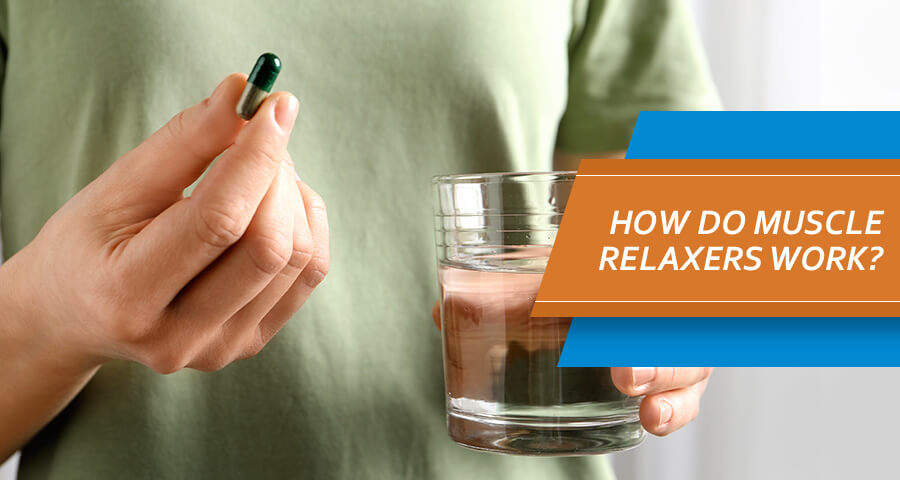
Physicians often prescribe muscle relaxant medications to individuals experiencing muscular spasms, seizures, and cramps. Muscle relaxants work differently depending on the severity of the contraction and the causes. For some individuals who recently started their treatment, the common questions are: how do muscle relaxers work and how long does it take for muscle relaxers to kick in? Let’s take a look at factors controlling muscle relaxants mechanisms of action and process of how muscle relaxers work.
Muscle Relaxants Mechanisms Of Action
Injuries to the head or muscular strain may cause spasms as well as medical conditions such as cerebral palsy, multiple sclerosis, and others. So, how do muscle relaxers work? There are various categories of medication, and each muscle relaxants mechanism of action is restricted to a specific location in the body. They relieve contractions, tense muscles, and stiffness in the tissues, and this is done in different ways.

Two categories of muscle relaxants are:
- neuromuscular blockers,
- spasmolytics or antispasmodics.
The neuromuscular blockers interfere with chemical transmissions at the endplates. They don’t affect the CNS, while the spasmolytics are known to ease muscular tension by interacting with GABA receptors as an agonist and acting on the CNS in a wide variety of neurological disorders ensuing hyperpolarization of neurons.
Contractions stemming from the brain and spinal cord. Some muscle relaxers work specifically on the central nervous system, which directly affects the brain and the spinal cord. Some of these types of medication include Methocarbamol, Baclofen, and Tizanidine.
Contractions in the muscles. Medications such as dantrolene restrict themselves to relieving muscular stress. Its restriction to the muscular tissue makes it one of the safest relaxers with fewer side effects, unlike those that have a direct impact on the CNS. This is why a physician will most likely prescribe this drug as the first choice.
The mechanism of action of skeletal muscle relaxants in classed with the spasmolytics. Other tissue-related mechanisms are neuromuscular, such as muscle relaxers for menstrual cramps.
How Long Does It Take For Muscle Relaxers To Act?
From the moment one ingests a pill, the most common question is usually: how long does it take for muscle relaxers to work? There are factors that may be responsible for either delayed or immediate potency but generally, the time it takes for muscle relaxers to kick in may hinge on differentials such as weight, body fat, and others.
So, how long do muscle relaxers take to work? It takes about 30 minutes or more after it is ingested. Peak efficacy may linger around 2 to 4 hours. When one ingests the drug orally, it disintegrates and enters the bloodstream where it is then distributed to various tissues, organs, and CNS. The progression might take up to 30 minutes before results may be experienced.
How long do muscle relaxers work? In many cases, they may last about 12 hours or more. In some cases, delayed efficacy may be due to numerous factors that only a medical doctor can understand. At this point, it is inadvisable to take more doses of the medication unless advised otherwise.
Intravenous drugs are usually administered by means of an injection directly into the veins. It is the shortest route for taking them because it goes directly into the bloodstream and becomes effective in less than 10 minutes.
Using Muscle Relaxers Safely
Do muscle relaxants show up on a drug test? No, they don’t. This is because they are not classified as illicit substances and so they won’t be an aim of a regular drug test, but specific tests can detect them.
Weed and muscle relaxers are a risky combination as they both amplify the effects of the other. Similarly, drinking on muscle relaxers is a bad idea; the reason being that alcohol is a depressant which causes the body to relax. Naturally, these drugs cause a feeling of relaxation, drowsiness, and this can become intense when one drinks.
To minimize these effects, otc muscle relaxers and off-labels such as Acetaminophen and Ibuprofen are often the go-to medication for acute pains and contractions; however, their action may cause drowsiness. Muscle relaxant herbs and other all-natural medicines can be the safest way for mild pain in tissues.
A lot of these meds are depressants and have a tendency for abuse as it affects the CNS. Abusers could easily build tolerance for the drug and would need to increase their dose in order to get results while on the medication. A rehab program is also a great choice for individuals who may be dependent on the drug. The numerous facilities offer drug detoxification, medicine therapies, and counseling to alleviate dependencies.

Published on:
Updated on: